
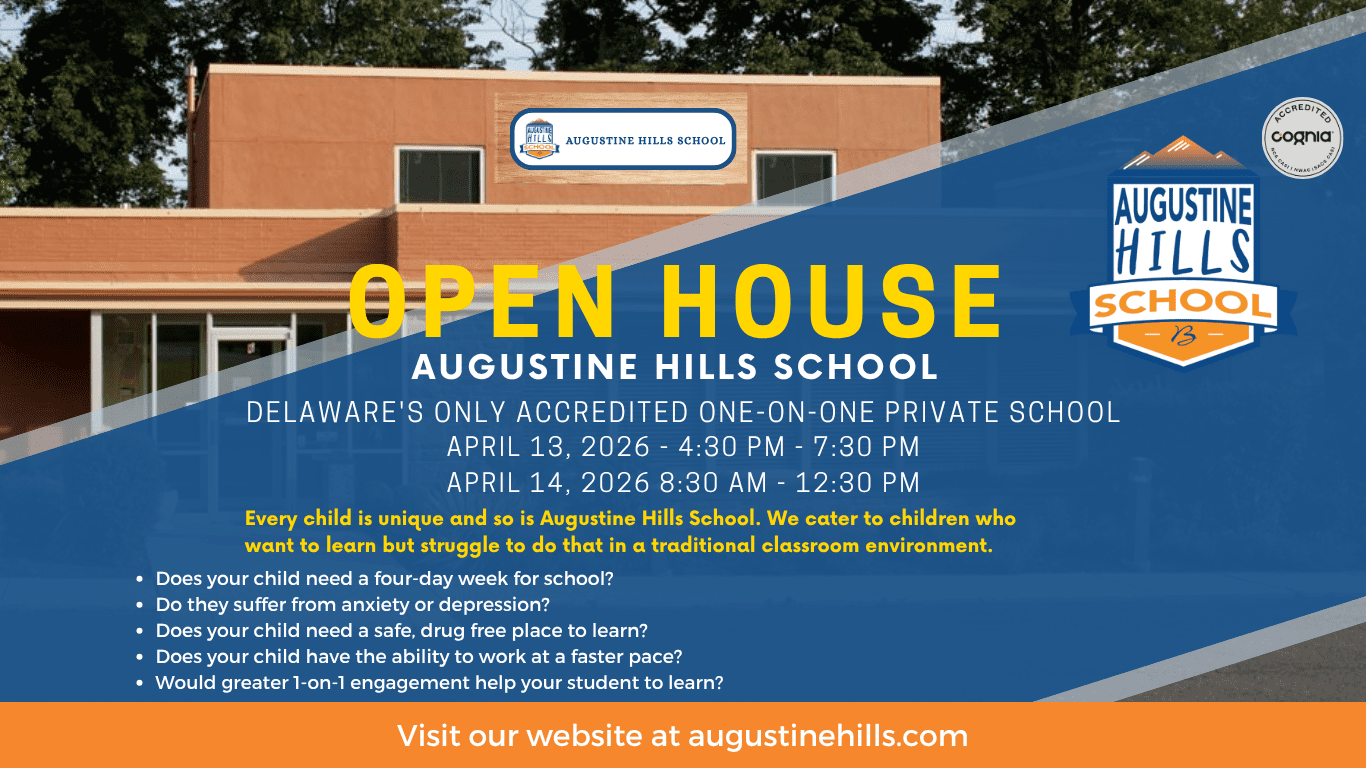
Augustine Hills School Open House
by Admin | March 23, 2026
What if school was actually built around your child?
Augustine Hills School is opening its doors this April and wants to show you what truly personalized education looks like.
Read More
 Monday, April 13th | 4:30 – 7:30 PM Tuesday, April 14th | 8:30 AM – 12:30 PM
 - 1:1 personalized learning — every lesson is tailored to your child
- Flexible scheduling — in-person, hybrid, and online options
- A supportive environment — ideal for students with anxiety, learning differences, or those who simply thrive with more individual attention
- Grades 6–12 — serving middle and high school students
- Struggle in traditional classroom environments
- Need a more flexible or personalized schedule
- Deal with school anxiety or learning differences
- Are capable of more but need the right environment to thrive
- Would benefit from a closer relationship with their teacher
April 13th | 4:30–7:30 PM April 14th | 8:30 AM–12:30 PM 6 Stone Hill Road, Wilmington, DE 19803
  302-594-0685
  augustinehills.com
by Admin | March 11, 2026 | Resources
SCHOOL REFUSAL IS NOT WHAT YOU THINK IT IS: what Every Parent needs to Know
School refusal is more than a child simply not wanting to go to school.
Read More
School refusal is a growing concern among parents, educators, and mental health professionals. It refers to a child’s inability or unwillingness to attend school regularly, often resulting from anxiety, stress, or other emotional challenges. Understanding the causes, recognizing the signs, and knowing how to address school refusal is crucial for supporting affected children.
What is School Refusal?
School refusal is not simply a desire to skip school; it involves a complex interplay of emotional and psychological factors. Children may experience significant distress about attending school, leading to avoidance behaviors. This can manifest in various ways, from frequent absences to physical symptoms like stomachaches or headaches.
Common Causes of School Refusal
Anxiety and Stress:
- Generalized Anxiety Disorder (GAD), Social Anxiety Disorder, and Specific Phobias can contribute to school refusal.
- Fear of bullying, academic pressure, or social situations can exacerbate anxiety.
Family Dynamics:
- Family issues, such as divorce or illness, can create instability and stress, making school attendance challenging.
- Overprotective parenting may also contribute to a child’s reluctance to separate from their family.
Learning Difficulties:
- Undiagnosed learning disabilities can lead to frustration and a lack of confidence, resulting in avoidance of school.
Transitions and Changes:
- Moving to a new school, changing grades, or shifts in routine can trigger anxiety and lead to school refusal.
Signs of School Refusal
Recognizing the signs of school refusal is essential for timely intervention. Look for:
- Frequent Absences: Regularly missing school days without a valid reason.
- Physical Symptoms: Complaints of headaches, stomachaches, or other ailments that seem to arise before school.
- Emotional Distress: Expressions of fear, panic, or sadness related to attending school.
- Social Withdrawal: Avoiding friends or school-related activities.
Strategies for Addressing School Refusal
- Open Communication:
- Encourage open dialogue about school feelings. Ask your child about their experiences, fears, and emotions.
Professional Support:
- Consult a mental health professional or school counselor to assess the situation and develop coping strategies.
Gradual Exposure:
- Gradually reintroduce your child to the school environment. Start with short visits, then slowly increase the duration.
Create a Supportive Environment:
- Foster a supportive home environment by providing encouragement and reassurance. Celebrate small victories to build confidence.
Establish Routines:
- Consistent morning and evening routines can help reduce anxiety and create a sense of stability.
Work with the School:
- Collaborate with teachers and school counselors to create a supportive plan tailored to your child’s needs.
School refusal is a multifaceted issue that requires patience, understanding, and a collaborative approach between parents, educators, and mental health professionals. By identifying the underlying causes and implementing supportive strategies, we can help children overcome their fears and thrive in the school environment.
If you suspect your child is experiencing school refusal, don’t hesitate to seek help. Early intervention can make a significant difference in their educational journey and overall well-being.
Sure! Let’s dive deeper into some key aspects of school refusal, including its impact, additional strategies for support, and resources for parents and educators.
The Impact of School Refusal
- Academic Consequences
- Learning Gaps: Frequent absences can lead to significant gaps in knowledge and skills, making it harder for the child to catch up.
- Decreased Motivation: Continuous refusal can result in a lack of interest in academics, affecting long-term educational outcomes.
Emotional and Social Effects
- Isolation: Children who refuse school may miss out on social interactions, leading to feelings of loneliness and isolation.
- Increased Anxiety: The longer a child avoids school, the more entrenched their anxiety can become, potentially leading to a cycle that’s difficult to break.
Family Stress
- Tension at Home: Parents may experience frustration, guilt, or helplessness, creating strain in family relationships.
- Impact on Siblings: Other siblings may feel neglected or stressed as parents focus on the child who is refusing school.
Additional Strategies for Support
- Building Resilience
- Encourage Problem-Solving: Help your child develop problem-solving skills to tackle school-related challenges. Role-playing scenarios can be effective.
- Foster Independence: Gradually encourage your child to take on responsibilities, promoting self-confidence.
Mindfulness and Relaxation Techniques
- Breathing Exercises: Teach your child simple breathing exercises or mindfulness techniques to help manage anxiety.
- Physical Activity: Regular physical activity can reduce stress and improve mood.
Positive Reinforcement
- Set Goals: Work with your child to set small, achievable goals related to school attendance and participation.
- Reward Progress: Establish a reward system to celebrate accomplishments, reinforcing positive behaviors.
Collaboration with School Staff
- Individualized Support Plans: Work with teachers to create a tailored plan that accommodates your child’s needs, such as modified assignments or a gradual return to school.
- Safe Spaces: Identify safe areas in the school where your child can go if they feel overwhelmed.
Resources for Parents and Educators
Books and Guides
- “The Anxiety Workbook for Teens” by Lisa M. Schab: A practical guide for teens dealing with anxiety.
- “Helping Your Child Overcome Separation Anxiety or School Refusal” by Andrew A. G. W. McMahon: A resource for parents navigating similar challenges.
Online Resources
- National Association of School Psychologists (NASP): Offers articles and resources on school refusal and related topics.
- Child Mind Institute: Provides helpful articles, guides, and expert advice on supporting children with anxiety and school refusal.
Professional Help
- Therapists and Counselors: Engage with mental health professionals specializing in childhood anxiety or school refusal.
- School Psychologists: Many schools have psychologists who can work directly with your child and provide strategies for coping.
Conclusion
School refusal can be a challenging experience for both children and their families. However, with understanding, proactive strategies, and the right support, children can overcome their fears and successfully return to school. Remember, early intervention is key, so don’t hesitate to reach out for help if needed.
If you have specific questions or need further details on any aspect, feel free to ask! Our School, Augustine Hills specializes in helping students catch up academically and emotionally as they are receiving help. Contact us today at 302-594-0685 or info@backtobasicslearning.com for more information on how we can help.
Augustine Hills School Earns Accreditation
by Admin | February 26, 2026 | News
We are proud to announce that Augustine Hills School has officially received accreditation, affirming our commitment to academic excellence and student-centered learning. This recognition validates what our students and families already know — that a personalized, supportive education can meet and exceed the highest standards in private education.
Read More
Augustine Hills School Earns Cognia Accreditation
Wilmington DE – February 12. 2026 – Augustine Hills School announced today that it has earned Cognia®
Accreditation. Cognia is a nonprofit organization that provides quality assurance for schools, school districts,
and education service providers.
“Accreditation as conferred by the Cognia Global Accreditation Commission provides Augustine Hills
School a nationally recognized mark of quality for our school,” shared Juli Bennett, “It demonstrates to our
community our commitment to excellence, our willingness to enact meaningful change based on evaluation
and feedback, and our desire to be the best we can be on behalf of the students we serve.”
Cognia recognizes schools across the globe that meet rigorous standards focused on productive learning
environments, equitable resource allocation, and effective leadership. To earn Cognia accreditation, a school
must submit to internal and external review. Earning accreditation from the Cognia Global Accreditation
Commission means that the school meets Cognia Performance Standards and maintains a commitment to
continuous improvement. Schools in good standing can maintain their accreditation for a six-year term.
Dr. Mark A. Elgart, president and CEO of Cognia, stated, “Cognia Accreditation is a rigorous process that
focuses the entire school and its community on the primary goal of ensuring all students can flourish in
engaging and equitable learning environments. We commend Augustine Hills School for meeting high
standards and making progress on key indicators that impact student learning.”
Cognia is the parent organization of the North Central Association Commission on Accreditation and School
Improvement (NCA CASI), Northwest Accreditation Commission (NWAC) and the Southern Association of
Colleges and Schools Council on Accreditation and School Improvement (SACS CASI). Parents and
interested community members can learn more about Cognia Accreditation at cognia.org
About Cognia
Cognia is a global, nonprofit improvement organization dedicated to helping institutions and other education
providers grow learners, teachers, and leaders. Cognia offers accreditation and certification, assessment, and
improvement services within a framework of continuous improvement. Serving 40,000 public and private
institutions from early learning through high school in more than 90 countries, Cognia brings a global
perspective to advancing teaching and learning. Find out more at cognia.org.
About Augustine Hills School
Augustine Hills School is a private school in Wilmington, DE serving students in grades 6 through 12. We
offer a traditional academic curriculum in a uniquely supportive setting: a true 1:1 model where each student
is paired with a dedicated teacher for every class. Instruction is offered in person or through a hybrid format,
ensuring flexibility without compromising academic quality.
This individualized approach draws on the research of educational psychologist Benjamin Bloom, who found
that students taught one-on-one using mastery learning techniques performed two standard deviations better
than those taught by conventional methods.
Augustine Hills School is a strong fit for students who:
• Experience school-related anxiety or depression
• Have been bullied in traditional school settings
• Need a flexible academic schedule
• Are in recovery or undergoing treatment
• Are transitioning between schools
At Augustine Hills School, our mission is to unlock each student’s full potential through a safe, inclusive,
transformative, one-on-one educational experience. We create a personalized learning environment for
students who flourish beyond the limits of traditional classrooms—those who benefit from flexibility,
individualized attention, emotional support, and a customized academic path.

3 ways to inspire a back to school love of learning
by Admin | Aug 16, 2019 | News
AS THE NEW SCHOOL YEAR BEGINS, THINK BEYOND THE NEXT TEXT GRADE AND INSPIRE YOUR CHILD TO DISCOVER A TRUE LOVE OF LEARNING.
Read More
While legions of children may wish otherwise, it’s back to school time! This school year, you can inspire your children to academic achievement, not just with the outward trappings of success like an A in Calculus or an award-winning Science Fair project, but with a true love of learning.
What is a love of learning or intellectual curiosity, exactly? According to Michael Austin in a recent article in Psychology Today, “The intellectually curious person has a deep and persistent desire to know. She asks and seeks answers to the “why” questions. And she doesn’t stop asking at a surface level, but instead asks probing questions in order to peel back layers of explanation to get at the foundational ideas concerning a particular issue.”
Intellectual curiosity is what drove brave explorers to cross the Atlantic Ocean in search of the New World, what propelled Thomas Edison to experiment with over 2,000 filaments before achieving success, and what has ignited the passion behind each new discovery throughout the ages.
According to education experts, the amount of intellectual curiosity displayed by students directly correlates to academic performance. While “learning to the test” may have some short-term rewards, academic achievement preceded by intellectual curiosity is a far more accurate indicator of eventual success.
So, how can parents inspire children with a love of learning that will stand them in good stead for the rest of their lives? Here are three simple approaches parents can implement to spark a passion for knowledge in children of all ages.
1. Children model what they see. A parent is a child’s first, and most important, teacher. From early infancy onward, children absorb like sponges life lessons like how to walk, talk, and feed themselves. Yet other vital lessons are also taught, often unconsciously. Parents can use this modeling behavior by displaying a love of learning in their own lives.
Whatever inspires you, whether it’s ancient Greek architecture, digital photography, or propagating new roses, get excited about it and share that enthusiasm with your kids. Take books out of the library. Do online research. Visit an exhibit. Your lifelong learning and active pursuit of knowledge will show your children more than you could ever simply tell them.
2. Explore real-world applications to learning. Some students are apathetic about school subjects because they can’t understand the real-world applications to “book learning.” A common refrain is often, “But this book report/science lab/math project is so meaningless!”
Pointing out how often we actually do use what’s learned in school can be a real eye-opener. Plus, by creating a link between what is learned in school to existing passions, a need to know more is established. For example, if your student dreams of a career as a film animator, nurse, or astronomer, explain how a solid background in math can help, and how many diverse careers use math every single day. If possible, show or connect your child with examples. A conversation with teachers or counselors will often lead to some real-world connections.
Although your child’s dreams of discovering new planets may never materialize, by sparking that desire to learn more, watching the heavens as a backyard astronomer may become a lifelong pursuit.
3. Provide them with opportunities to further an interest. If your child has an interest in bugs, a visit the Museum of Natural History is a natural first step. But also do some online research into how bugs are being used to cure diseases. Or if their passion is music, take your child to a free concert in a genre that is completely outside their primary interest area. From country, to reggae, to classical, you’ll be opening their eyes to a completely new musical experience.
The key, whatever your child’s initial interest, is to help them expand and grow, learning more, questioning more, and developing a true thirst for knowledge.
At Augustine Hills School, the 1:1 teacher-to-student ratio means that your child has the constant attention of the teacher.
Your child can listen without distraction. They can speak and ask questions without fear. And their learning style, interests, and pace are their teachers’ primary focus, all day, every day.
If this sounds like the right environment for your student, don’t suffer through another unsuccessful school year. Contact us to get started.

Rebranding as Augustine Hills School
by Admin | Aug 16, 2019 | News
Formerly known as Back to Basics Private School, Augustine Hills School in Wilmington, DE has the same ethos and now a chest-puffing name to go with it.
Read More
We’re excited to re-launch Back to Basics Private School as Augustine Hills School.
Why change the name?
In a word PRIDE!
Kids take pride in where they attend school. We think it’s important that students chests swell when they are asked, “Where do you go to school?”
Augustine Hills School is such a place. And now it has a name to match.
Formerly known as Back to Basics Private School, Augustine Hills has much of the same ethos and now a chest-puffing name to go with it.
What students are an ideal fit for Augustine Hills?
• Students who need a safe place to retool. Kids who find themselves engulfed in social, emotional or health turmoil as a result of circumstances beyond their control. Students who have been bullied, injured or simply need to recenter themselves can excel at AHS.
• Students who need extra help. While no student should be left behind, it happens every day. If you have a student who learns differently and has ADD, ADHD or Dyslexia to name a few, it is hard to keep pace in a traditional classroom of 25-30 students. AHS can be your answer.
• Gifted and talented students. Increasingly, there are students who are blessed with concentrated interests and talent for a unique gift or vocation above all else. Often these prodigies have exemplary talents in athletics, academics or arts. Whether trying to be a professional athlete, a chess grand master or a world class musician, pursuit of these vocations may conflict with a typical school day. AHS can be just the solution.
About our Curriculum
All instruction at Augustine Hills is:
•Student centered – tailored to the unique needs, interest and schedule of your student. There is no one size fits all. Students are moved along at their pace – not the pace of the pack.
•Personalized – one-to-one instruction means to accelerate progress with no “hiding” from the teacher. We use differentiating teaching methods that are best suited to each student. Regardless of the intervention needed, we will find and deploy a technique that works!
•Safe – lacking crowded hallways, locker rooms and an intimidating cafeteria, all of our students enjoy a friendly environment conducive to learning. Quiet study rooms, a small break room, friendly teachers and a welcoming staff are all in abundant supply at AHS.
So when your student gets asked where they go to school, they will be proud to reply Augustine Hills School. And when asked where it is, they will confidently reply “in Augustine Hills of the Augustine cut-off”.
And best of all, when asked what kind of school is it. They will confidently say “it’s a private school where I get personalized instruction, on my terms and on a schedule that the way I like it”.
Augustine Hills School.
Personalized teaching. Accelerated learning. Student success.

How school anxiety impacts teens (and how parents can help)
by Admin | Jul 2, 2019 | Resources
School anxiety can be a major factor that gets in the way of success for some teenagers. Read some strategies to help your teen overcome the hurdles.
Read More
Back to school is an exciting time for high school students— but it can also produce school anxiety for many young people.
The season reunites teens with best friends and favorite teachers, as well as means a return to highly anticipated dances and fun-filled sporting events.
Of course, there is also plenty of frenzied studying, late nights writing endless essays, and double shot Starbucks espressos. If your student is high school senior applying to college, add college applications and scholarship to the mix.
The combination can lead to anxiety… lots of it.
“Given the array of changes and uncertainties facing a normal teenager, anxiety often hums along like background noise. For some teenagers, anxiety becomes a chronic, high-pitched state, interfering with their ability to attend school and to perform up to their academic potential. Participating in extracurricular activities, making and keeping friends, and maintaining a supportive, flexible relationship within the family become difficult. Sometimes anxiety is limited to generalized, free-floating feelings of uneasiness. At other times, it develops into panic attacks and phobias,” says the American Academy of Child & Adolescent Psychiatry.
Is your teen suffering from anxiety?
For parents, the difference between general “senior stress” and acute anxiety may be difficult to determine. However, symptoms may include:
- excessive fears and worries,
- feelings of inner restlessness, and
- a tendency to be excessively wary and vigilant.
Even in the absence of an actual threat, some teenagers feel nervousness, restlessness, or feelings of anxiousness.
Stress affects more than just your teen’s mood
Stress produces a physiological reaction in the body. Specifically, hormones are released which can slow down digestion, induce shaking, tunnel vision, accelerated breathing and heart rate. This is commonly referred to as the “fight or flight response.”
The fight or flight response, explains Dr. Tian Dayton in the Huffington Post, “was designed to be used in times of danger, not throughout the day. But the body can’t tell the difference between real and fabricated fears, between the stress of a bad phone call, a traffic jam and an elephant charging — it will react to all with the same highly-geared stress response evolved by early man. Our stress response is inextricably tied up with our survival system, which is triggered into action through fear.”
While fear of a poor Calculus grade and fear of being eaten by a tiger are not the same, the body simply can’t tell the difference.
How parents can help teens deal with stress and anxiety
- Stop overscheduling. Kids are expected to pay attention in school for seven hours, excel at extracurricular activities and sports, come home, finish homework, and go to bed, then do it all again the next day with no downtime.
- Play! Younger kids will do this naturally, but older kids may forget how to simply play. Some ideas include: riding your bikes, throwing around the baseball, wrestling and hiking.
- Catch up on the ZZZs. Sleep is vital for everyone, regardless of age. Proper rest helps minimize stress, boost moods, and even improve school performance. Creating a restful bedroom environment (no electronics!) is crucial.
- Manage parental stress. Stress really is contagious!
- Start the morning off right. Disorganization is a major contributor to stress levels for everyone in the house. Prepare the night before for the next day. Lay out clothes and shoes, pack backpacks, prepare lunch and pop in the fridge, sign all papers, notes, and permission slips, and make sure there is a healthy breakfast available.

Failure, mastery and resiliency
by Admin | Jul 2, 2019 | Resources
No matter how tempting it may be to swoop in to rescue your child from failure, experts agree that this behavior is actually damaging to children.
Read More
Allowing kids to fail (some) helps them succeed in the long run.
For a parent, watching a child struggle is difficult. Sitting idly by while they fail can feel downright impossible. No matter how tempting it may be to swoop in to rescue your child in times of distress, experts agree that this behavior is actually damaging to children.
According to psychologist Michael Ungar, head of the Resilience Research Centre at Dalhousie University, “The point of parenting should be to grow a child who is capable of taking on adult tasks.”
Easier said than done, think many parents. And, worry can often drive parents to take control. But, these good intentions are destined to backfire.
“By not allowing children to falter or experience disappointment, you render them helpless—the precise opposite of what most parents hope to achieve,” explains Susan Newman Ph.D. in a recent article for Psychology Today.
Of course, “failure” comes in many forms. So, if you are ready to “give your child wings,” it’s important to create opportunities where the child can fail in a safe environment, learn from the experience, master a new skill and eventually become more resilient.
Some simple tips for parents include:
- Stop hovering. Step away when a child is learning something new.
- Create opportunities for success. The memory of repeated success builds resiliency.
- Resist the urge to simply tackle a task yourself, rather than watch your child struggle. They can’t learn if they never try.
- Don’t share your worries about competence with your child.
- Never label your child or compare one child to another.
- Although it’s difficult, try not to take it personally if your child doesn’t agree with you, or does things differently from you, or experiences failure.
What’s the best approach? Let your child experience the consequences of their actions and allow them to make mistakes, face consequences, and (within reason) solve their own problems.